
What is Geisha Coffee? Why It’s the World’s Most Expensive Coffee
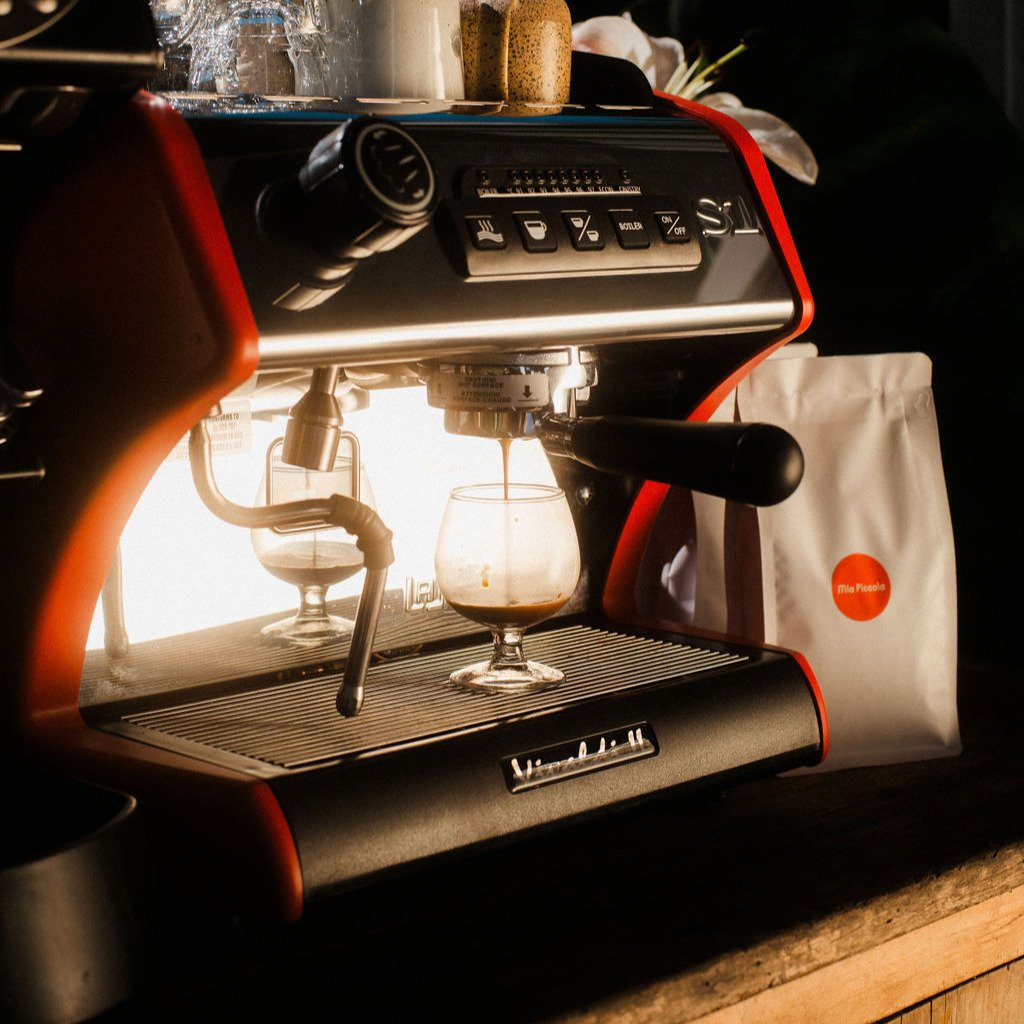
If you’ve spent any time hanging out with us, you know we love a good cup with a great backstory. We’ll talk your ear off about grind sizes, mid-century glassware, or the exact temperature needed to make a pour-over pop. But every now and then, a coffee comes along that stops even the biggest coffee nerds dead in their tracks.
Enter Geisha coffee (often spelled Gesha).
If you’ve ever walked into a specialty roastery and seen a single pour-over listed for $15, $20, or even $50 a cup, chances are you were looking at a Geisha. At green coffee auctions, prized lots of these beans have fetched upwards of $1,000 to $2,000 per pound.
Is it just clever marketing hype, or is there genuine magic sitting inside that bag? Today, we’re taking a deep dive into the world’s most exquisite coffee varietal—where it came from, what it actually tastes like, and why it commands such sky-high prices.
What is Geisha Coffee? (And the Japan Myth)
Let’s clear up the biggest point of confusion right out of the gate: Geisha coffee has nothing to do with Japan.
Despite the name, this rare Arabica varietal is wild and native to Africa. It was originally discovered in the 1930s in the mountainous, southwestern region of Ethiopia—specifically near the Gori Gesha forest.
When British researchers collected samples of the wild trees in 1936, the name was transliterated into English as "Geisha." Both spellings—Gesha and Geisha—are used interchangeably in the coffee world today. "Gesha" pays homage to its Ethiopian roots, while "Geisha" became the global trade name that took the specialty coffee scene by storm.
From Ethiopia to Panama: The Cinderella Story
So how did a wild Ethiopian forest tree end up becoming the crown jewel of Central American coffee farming? It was a decades-long journey full of plot twists.
1930s – 1950s: After being cataloged in Ethiopia, seeds were brought to research stations in Kenya and Tanzania, eventually landing at CATIE (a agricultural research center) in Costa Rica during the 1950s.
1960s: Farmers in Panama began planting Geisha trees because the variety showed natural resistance to coffee leaf rust (a devastating fungal plant disease). However, because the trees were planted at lower altitudes, the coffee tasted fairly average, and farmers mostly ignored it.
2004 (The Breakout Moment): Everything changed when the Peterson family at Hacienda La Esmeralda in Boquete, Panama, noticed a group of unusual, tall coffee trees growing at extreme high altitudes on their farm. They decided to harvest and process those cherries separately.
When the judges tasted that micro-lot at the 2004 Best of Panama competition, it blew the doors off the industry. It didn't taste like any Central American coffee anyone had ever experienced—it tasted like a bouquet of fresh flowers, bergamot, and sweet stone fruit. It shattered competition scoring records, ignited an international bidding war, and changed specialty coffee forever.
Today, geisha coffee is known as an expensive staple for any 4th wave at-home coffee setup.
What Does Geisha Coffee Taste Like?
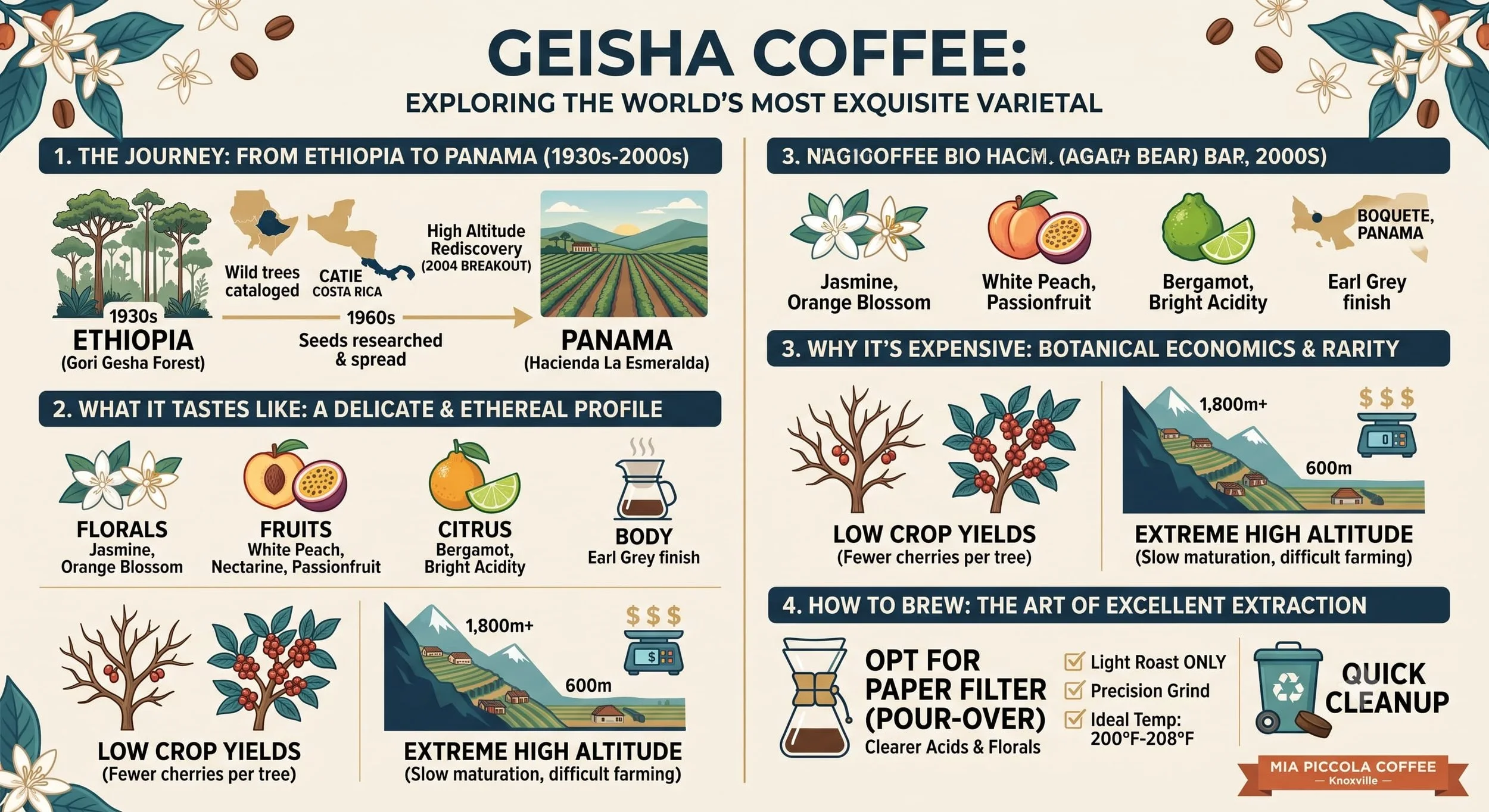
If a traditional cup of coffee tastes like dark chocolate, toasted nuts, and heavy caramel, Geisha coffee is its delicate, ethereal cousin.
Drinking a well-brewed Geisha is often compared to drinking a high-end perfumed tea. Instead of heavy, roasty notes, Geisha is celebrated for its sparkling clarity, vibrant acidity, and intense floral aromatics. By making Geisha in a Kalita Wave, you’ll bring out its deep fruit sweetness and a more rounded body.
Common tasting notes include:
Florals: Jasmine blossom, orange blossom, honeysuckle, and rose.
Fruits: White peach, nectarine, passionfruit, bergamot, and sweet papayas.
Body & Finish: Silky, tea-like, with a long, clean finish resembling Earl Grey tea.
It’s an insanely complex sensory experience—the kind of cup where every time the coffee cools down a degree or two, a completely new flavor note pops up. Stop by one of our coffee bars in Knoxville, and we might just serve geisha in the future for you to taste yourself!
Why Is Geisha Coffee So Expensive?
It’s easy to look at a $20 cup of coffee and wonder if someone’s taking you for a ride. But the eye-watering price tag of Geisha coffee comes down to basic botanical economics: it is exceptionally difficult to grow, incredibly rare, and intensely sought after.
1. Low Crop Yields & Delicate Trees
Geisha trees are notoriously fickle. They have shallow, brittle root systems that don't anchor well in strong mountain winds, and their branches produce far fewer coffee cherries than standard commercial varieties like Bourbon or Caturra. Farmers harvest significantly less coffee per acre when they choose to plant Geisha.
2. Extreme Altitude Requirements
To unlock those legendary floral notes, Geisha trees must be grown at extreme elevations—typically above 1,500 to 2,000 meters (nearly 6,000 feet) above sea level. Farming at those heights means colder nights, slower cherry maturation, steep hillside terrain, and difficult harvesting conditions.
3. Meticulous Hand Sorting
Because a single green or overripe cherry can spoil an entire micro-lot, farm workers hand-pick only the absolute peak-ripe cherries. Processing methods (whether washed, natural, or experimental anaerobic fermentations) require round-the-clock monitoring and precision.
4. Global Competition & Auction Bidding
Supply is tiny, but demand from high-end roasters, competition baristas, and collectors in Japan, Asia, Europe, and the US is massive. When micro-lots go to online auction, international roasters bid thousands of dollars per pound to secure just a few bags for their customers.
How to Brew Geisha Coffee at Home
If you ever treat yourself to a bag of Geisha beans, you want to treat them like gold. The cardinal rule of Geisha coffee is simple: never dark roast it, and keep your extraction clean.
The Roast: Geisha is almost exclusively given a light roast. Dark roasting burns off those delicate jasmine and bergamot compounds, destroying what makes the bean special in the first place.
The Brew Method: Opt for a paper-filtered manual pour-over like a Chemex or a Hario V60. The dense paper filters remove heavy oils, allowing those bright fruit acids and floral aromatics to shine through with crystal clarity.
Water Temperature: Keep your water near-boiling (around 200°F – 208°F) and use a clean, balanced water recipe to highlight the sweetness without extracting harsh bitterness.
Is Geisha Coffee Worth the Hype?
If you’re looking for a heavy, dark, dark-chocolate caffeine kick to get you through a Monday morning commute, Geisha probably isn't what you're looking for.
But if you view coffee as an incredible craft—much like fine wine, single-malt whiskey, or artisanal tea—tasting a high-altitude Geisha is a bucket-list experience. It completely expands your idea of what a humble coffee bean is capable of producing.
Next time you drop by our coffee spot in Knoxville, ask us what single-origins we have on the bar. Whether it’s a vibrant East African pour-over or a special reserve micro-lot, we’re always excited to share something special with you!